


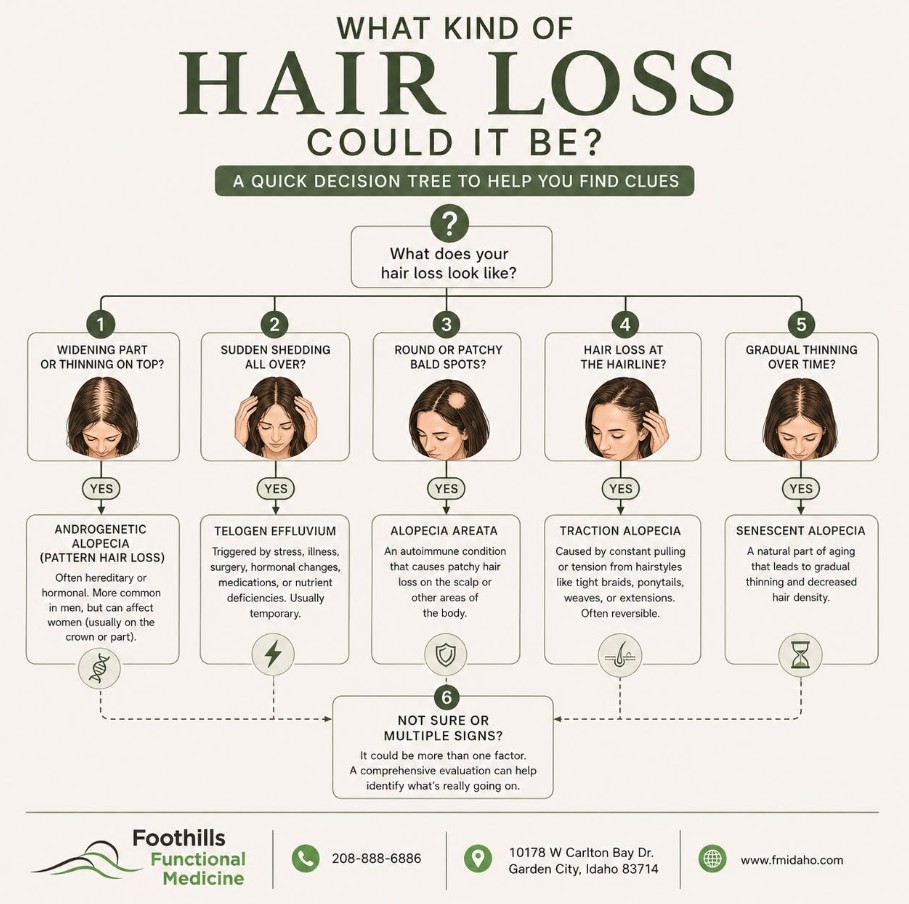
What Kind of Hair Loss Could It Be?
If you’ve noticed more hair in your brush, on your pillow, or in the shower drain, you’re not alone — and it’s not always “just genetics.” Hair loss can show up in a lot of different patterns, and the pattern itself often points to what’s actually going on underneath.
At Foothills Functional Medicine, we don’t stop at “your hair is thinning.” We look for the root cause — because the right approach depends on knowing which type of hair loss you’re actually dealing with.
Here’s a quick way to think through it.
1. Widening Part or Thinning on Top
- This may be: Androgenetic Alopecia (Pattern Hair Loss)
- This is often hereditary or hormonal. It’s more commonly associated with men, but it affects women too — usually showing up as thinning along the crown or a widening part.
2. Sudden Shedding All Over
- This may be: Telogen Effluvium
- This type is triggered by things like stress, illness, surgery, hormonal changes, medications, or nutrient deficiencies. The good news: it’s usually temporary.
3. Round or Patchy Bald Spots
- This may be: Alopecia Areata
- This is an autoimmune condition that causes patchy hair loss on the scalp or other areas of the body.
4. Hair Loss at the Hairline
- This may be: Traction Alopecia
- This pattern is caused by constant pulling or tension — often from tight braids, ponytails, weaves, or extensions. It’s often reversible once the tension is addressed.
5. Gradual Thinning Over Time
- This may be: Senescent Alopecia
- This is a natural part of aging, leading to gradual thinning and decreased hair density over time.
Not Sure, or Seeing More Than One Sign?
That’s common — and it could be more than one factor at play. Hormones, stress, nutrient status, autoimmune activity, and styling habits can all overlap, which is exactly why a comprehensive evaluation matters more than guessing from a list.